
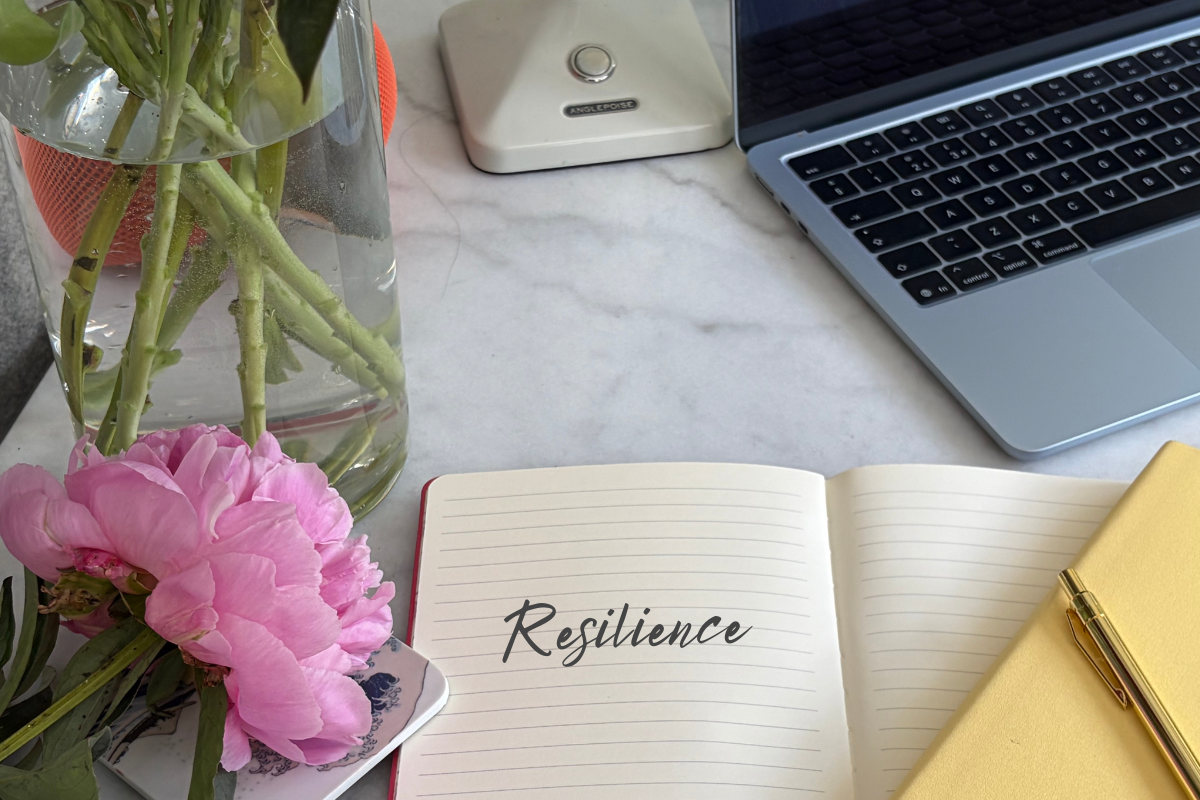
This is not an article about productivity. It’s about what happens when work gets overwhelming and your inner voice starts telling you it’s your fault. And how, unexpectedly, AI helped me interrupt that pattern and find my way back to solid ground.
There’s a particular kind of professional misery that doesn’t show up in any job description.
It’s the misery of carrying ambiguity. Of being in a situation where the process is unclear, the expectations are unstated, the history is patchy, and yet somehow — in the quiet of your own head — you have become the person responsible for all of it.
You run the situation over and over. You look for the moment where you went wrong. You take on responsibility for things that were never yours to begin with. And the spiral tightens.
I know this pattern well. I’ve lived it more times than I’d like to admit. And this week, in the middle of exactly that kind of situation, I did something that helped me more than I expected.
I talked to an AI.
A little history — and why I thought to try this
Years ago I came across an app called Woebot.
It was created to support young people with their mental health — a conversational AI built on cognitive behavioural therapy principles, designed to help people recognise and interrupt unhelpful thought patterns. I tried it and I remember thinking: this is something.
What struck me wasn’t the sophistication. It was the absence of judgment.
When you write to a human — even a trusted friend, even a therapist — there is a layer of performance. A part of you is aware of how you’re coming across. You edit yourself. You present a version of the situation that doesn’t make you look too bad, or too weak, or too much.
With Woebot, that layer disappeared. Because it wasn’t a person. It couldn’t think less of you. It had no memory of you from last week and no opinion of you for next week. You could write your actual thoughts — the unedited, embarrassing, circular, desperate ones — and something would respond with genuine, considered, non-judgmental reflection.
That experience stayed with me. The idea that the absence of human judgment creates a space where you can be more honest than you would be with another person. Not because the AI is better than a person. But because the thing you need in that moment isn’t wisdom. It’s objectivity. And objectivity is very hard to find when you’re emotionally in the middle of something.
This week
I’ve been carrying a complex, long-running situation at work. I’m not going to go into the specifics — client confidentiality and professional discretion matter — but the shape of it will be familiar to anyone who has managed a complicated account or project over a long period of time.
Ambiguous process. Unclear ownership. A history of decisions that weren’t fully documented. Gaps in records that made resolution harder than it should have been. And a moment this week where I needed to respond to a finance query, action something I hadn’t been clearly instructed to do, and do both in a way that didn’t make me look like I was blocking progress or failing to understand something I should have understood.
In the past, I would have handled this by going very quiet inside my own head and very busy in an unhelpful way. Running the situation on a loop. Asking myself where I went wrong. Wondering whether I should have anticipated this. Taking on responsibility for process gaps that existed long before I was involved.
It would spiral. And the spiral would make everything harder — the clarity I needed to respond well would be buried under the weight of self-criticism.
This week, instead, I opened Copilot.
What happened when I asked for help
I didn’t ask Copilot to write the email for me. I asked it to help me think.
I described the situation. I explained what I’d been asked to do, what information I hadn’t been given, what I was worried about, and what I needed the response to achieve. I told it I was concerned about being seen as blocking progress. I told it I wasn’t sure whether I was supposed to know something I didn’t know. I told it I felt exposed.
And something shifted almost immediately.
Because the AI did something I couldn’t do for myself in that moment: it separated the emotional charge from the objective reality.
It said — in various ways, across various iterations of thinking it through with me — that what I was experiencing wasn’t a knowledge gap. It was a process gap. That the instructions I hadn’t been given weren’t things I should have known or found. That the ambiguity I was carrying wasn’t mine to carry alone. That asking for clarity wasn’t an admission of failure. It was exactly what a senior professional should do.
It said: you’re not behind here. You’re not missing anything. You’re actually applying better control than the process itself gives you.
I want to be honest about what that sentence did for me.
It didn’t solve the problem. The situation was still complex. The email still needed to be written. The process gap was still real. But something loosened. The spiral slowed. I could think clearly again.
What AI does that a colleague can’t always do
A trusted colleague can offer something an AI can’t — the depth of human understanding, the shared history, the warmth of someone who actually knows you and your context.
But a trusted colleague also has opinions. A relationship with you. A stake in the situation. Sometimes — often — they are the last person you can be fully honest with about how frightened or confused or overwhelmed you actually are.
The AI has none of that. It has no stake in how you come across. It has no memory of the last time you struggled with something similar. It has no capacity to think less of you tomorrow. It responds to what you actually write rather than to a performance of what you wish you were feeling.
That absence of judgment is not a limitation. In certain moments, it is precisely the thing you need.
What it offers is perspective. The ability to see your situation from outside your own emotional charge. To have someone reflect back: here is what is actually happening, here is what is objectively true, here is what you do and do not have responsibility for.
That is what therapists call cognitive reframing. And it is one of the most powerful tools in building genuine resilience — not the resilience of gritting your teeth and pushing through, but the resilience of being able to see clearly when everything feels foggy.
The pattern I recognised in myself
I want to name something, because I think it might resonate with people reading this.
I have a pattern — and I suspect I’m not alone in it — of taking on responsibility for situations I didn’t create. Of looking for the moment I went wrong when the situation itself was wrong. Of believing, at some level, that the ambiguity or the difficulty or the mess must be attributable to something I failed to do.
I’ve thought about where this comes from. Partly from being someone who cares about doing things well. Partly from years in environments where the standards are high and the margins for error feel small. Partly — I think honestly — from being a woman in a senior role in an industry where the expectation of having all the answers sits heavier on some people than on others.
The spiral is the mind’s attempt to find control in an uncontrollable situation. If I can just identify what I did wrong, I can fix it. If I can just understand where the failure was, I can prevent it from happening again.
The problem is that when the situation is genuinely ambiguous — when there is no clear failure point, just accumulated complexity and unclear process — the spiral finds nothing and keeps searching.
AI interrupted that. Not by telling me everything was fine. But by helping me see, clearly and without judgment, what was actually mine and what wasn’t.
A practical suggestion
If you are going through something at work that feels overwhelming — a situation you keep running on a loop, a problem where you can’t find the solid ground — try this.
Open whichever AI tool you have access to. Copilot, Claude, ChatGPT — it doesn’t matter which.
Write out the situation as honestly as you can. Not the polished version. Not the version you’d tell a colleague. The actual version. What happened, what you’re afraid of, what you’re blaming yourself for, what you don’t know.
Then ask it to help you think through what is genuinely your responsibility and what isn’t. What you know and what you were never told. What the process requires and whether that process was ever clearly given to you.
You may be surprised by what becomes visible when you step outside your own emotional charge and look at it from the outside.
You don’t have to act on everything it says. You don’t have to treat it as a substitute for a trusted colleague, a mentor, or a therapist when those things are what’s needed. But as a first step — as a way of interrupting the spiral and finding enough clarity to move forward — it is more useful than I expected.
Why I’m sharing this
I am not usually someone who finds it easy to admit that a situation got under my skin. Senior professional life has a particular culture around this — the expectation of apparent competence, the performance of having it handled, the reluctance to show the underneath.
But I’ve been thinking a lot lately about what it would have meant to find something like this earlier. In the hard weeks of my career when I was running things on a loop and had no good way of stepping outside them. In the moments when I was carrying ambiguity that wasn’t mine to carry and didn’t have the language to put it down.
I feel genuinely fortunate to have had the tool available this week. Not because it solved everything. But because it helped me be a little kinder to myself at a moment when I needed it. And it helped me show up more clearly — for the situation, for the people around me, and for myself.
If this is useful to one person reading it, it’s worth having written.
A note on finding the right support
Woebot, the app I mentioned earlier, is no longer available to new users — it closed its consumer service in 2025. Worth knowing if you go looking for it. This space moves quickly, and no single app is ever the right answer for everyone.
If you’re looking for something for a young person in your life, Collective Psychology, a UK clinical psychology practice, maintain a well-curated list of apps for children and young people, put together by working clinicians rather than a marketing team.
But the single most useful thing I can tell you is this: if you or a young person in your life is struggling, the right first step is your GP. An app can be a genuinely useful complement, and a real first step when you’re not yet ready to say the actual thing to a real person. It’s never a substitute for what a GP can help you access — proper assessment, therapy, the right referral. No app, however well designed, can offer that.
If something in this resonated — a pattern you recognise, a situation that felt similar, a moment when you couldn’t find solid ground — I’d love to hear about it. Leave a comment below.
And if you know someone who might need to read this, please share it. Sometimes the most useful thing we can do for each other is pass something along at the right moment.